

Luis Garcia was selected to participate in the inaugural Teacher Leader Institute sponsored by Schools That Lead, an organization whose mission is to equip teachers to lead using the tools of improvement science to transform how schools improve from the classroom up, centering student voice, leveraging new data in new ways, and creating schools that work for the people inside them.
When analyzing my students’ progress in math, I noticed a persistent challenge: many of my 5th graders struggled to apply their multiplication and division skills when solving multi‑step word problems. They could often perform the operations in isolation, but became stuck when those skills were embedded in real‑world contexts. As new topics demanded our attention, it became clear they weren’t getting enough time or support to fully master these foundational problem‑solving skills.
To understand why, I examined the contributing factors. Some students had gaps in number sense, others struggled with reading comprehension, and many lacked fluency with basic multiplication facts. Several simply hadn’t had enough practice with multi‑step problems to feel confident. But the most significant issue was that students had not yet mastered a clear, consistent protocol for approaching word problems. Without a reliable process, they often felt overwhelmed before they even began.
After exploring different ways to strengthen my students’ problem solving skills, I decided to center my instruction around the Polya model. In How to Solve It, Polya (1945/2004) explains that true problem solving begins with understanding the problem before jumping into calculations, and that idea immediately connected to what I was seeing in my classroom. My students were often rushing to compute without first making sense of the situation. Polya’s four steps: read and understand the problem, make a plan, carry out the plan, and look back offer a simple but powerful structure that addresses exactly what my students needed to improve. Through consistent modeling, I intended to make the analytical habits of problem solving visible and explicit for my students. My goal was not only to teach them how to reach an answer, but also to explain their thinking behind each step.
With this in mind, I designed a small, testable change idea. For four weeks, I used the warm‑up portion of every math class to model a structured problem‑solving routine. Each day, I walked students through the same steps: read and understand the problem, plan a strategy, carry out the plan, and look back to check the answer. After modeling, students completed a similar problem independently. This daily repetition was meant to build confidence and automaticity. To monitor progress, students completed a weekly Friday exit ticket to show whether they could apply the routine on their own.
This approach became the foundation of my improvement cycle. I tracked student work through a change‑idea tracker and collected daily warm‑ups, exit tickets, notes on confidence, and the beginning of the year i-READY diagnostics data as a baseline. These sources helped me see not only whether students were improving, but how they were engaging with the process.
Throughout the four weeks, I modeled the routine daily and made small adaptations, such as adding visual reminders and sentence stems, to support students who needed more structure. Over time, students became more willing to attempt multi‑step problems and used the routine with increasing consistency.
When I reviewed the data at the end of the cycle, several patterns emerged. Students’ written work showed stronger reasoning, more accurate operations, and clearer explanations. Their exit tickets demonstrated steady improvement in accuracy and independence. I also saw meaningful growth in reading comprehension. Out of seven students, five exceeded expected growth based on their beginning-of-year I Ready results, one met expectations, and one maintained.
The Conclusion: A Simple Yet Transformative Idea
April Ferguson was selected to participate in the inaugural Teacher Leaders Institute sponsored by Schools That Lead, an organization whose mission is to equip teachers to lead using the tools of improvement science to transform how schools improve from the classroom up, centering student voice, leveraging new data in new ways, and creating schools that work for the people inside them. This mission aligned seamlessly with April’s own commitment to reflective practice and meaningful instructional change. Read more about how improvement science transformed her students’ reading at writing at EdNC.
SETTING AN AIM TO IMPROVE STUDENT READING AND COMPREHENSION
I began the quarter with a clear aim: I wanted my students to become stronger readers by becoming stronger thinkers. I focused specifically on improving their comprehension and writing skills with informational texts — an area where many of them had faced persistent challenges. Rather than relying on traditional comprehension drills, I turned to a strategy I believed could fundamentally shift the way my students processed information: CER writing — Claim, Evidence, Reasoning.
PRACTICE-BASED RESEARCH: THE INITIAL EVIDENCE OF IMPACT
From the very first week, I immersed my students in historical primary sources, using these complex texts as a gateway to deeper informational reading. I asked them not simply to read, but to analyze. Not just to summarize, but to construct arguments. Throughout the quarter, they drafted and revised CER responses to speeches, letters, photographs, and political cartoons. I examined their writing closely, looking for clearer claims, more purposeful evidence, and reasoning that demonstrated an understanding of cause and effect.
Early on, many students struggled. Their claims lacked clarity, their evidence was sparse, and their reasoning often drifted into retelling. I responded with intentional scaffolding, especially for my ESL and EC learners, ensuring that each student had access to the support they needed. As the weeks progressed, I began to see a noticeable shift. Students started selecting evidence more deliberately. Their explanations became more precise. Their writing reflected a deeper grasp of the historical content — and a more sophisticated understanding of how ideas connect. With each CER cycle, I gradually released supports and raised expectations, guiding them toward greater independence and analytical confidence.
USING IMPROVEMENT SCIENCE TO IMPROVE STUDENT READING AND COMPREHENSION
Embedded in my approach was the core discipline of improvement science. I treated each instructional cycle as a small test of change, studying student work, identifying patterns, and adjusting my supports accordingly. Improvement science emphasizes learning through iterative practice — trying something, studying its impact, and refining it. I embraced this mindset fully. Each CER assignment became both a learning opportunity for my students and a data point for my own professional inquiry. This disciplined, reflective process allowed me to respond quickly to student needs and continuously strengthen my instructional moves.
THE RESULTS: EVIDENCE OF IMPROVEMENT AND MEETING GOALS
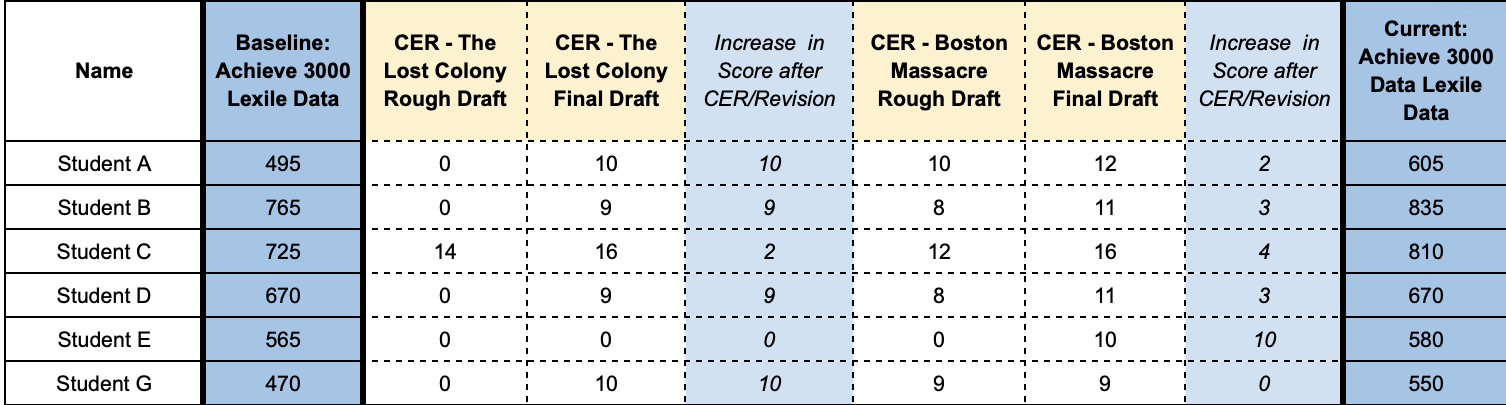
By the end of the quarter, I compared students’ early writing to their later drafts and paired those observations with Achieve3000 data focused on informational text performance across my three classes. The results told a compelling story.
-
5 out of 7 exceeded expected growth and gained an entire year’s worth of growth or more in one quarter
-
1 met the expected quarterly growth
-
1 maintained
Their CER writing had become stronger, and their reading comprehension data reflected the same upward trajectory.
THE CONCLUSION: A SIMPLE YET TRANSFORMATIVE IDEA
For April, the project affirmed what she believed from the start — that writing can be a powerful tool for developing deeper thinking and that it can unlock deeper comprehension. Her students didn’t just learn to write better; they learned to understand more fully. And in that growth, April saw the impact of a simple yet transformative idea, strengthened by the disciplined, reflective cycles of inquiry and carried out with consistency, curiosity, and empathy.